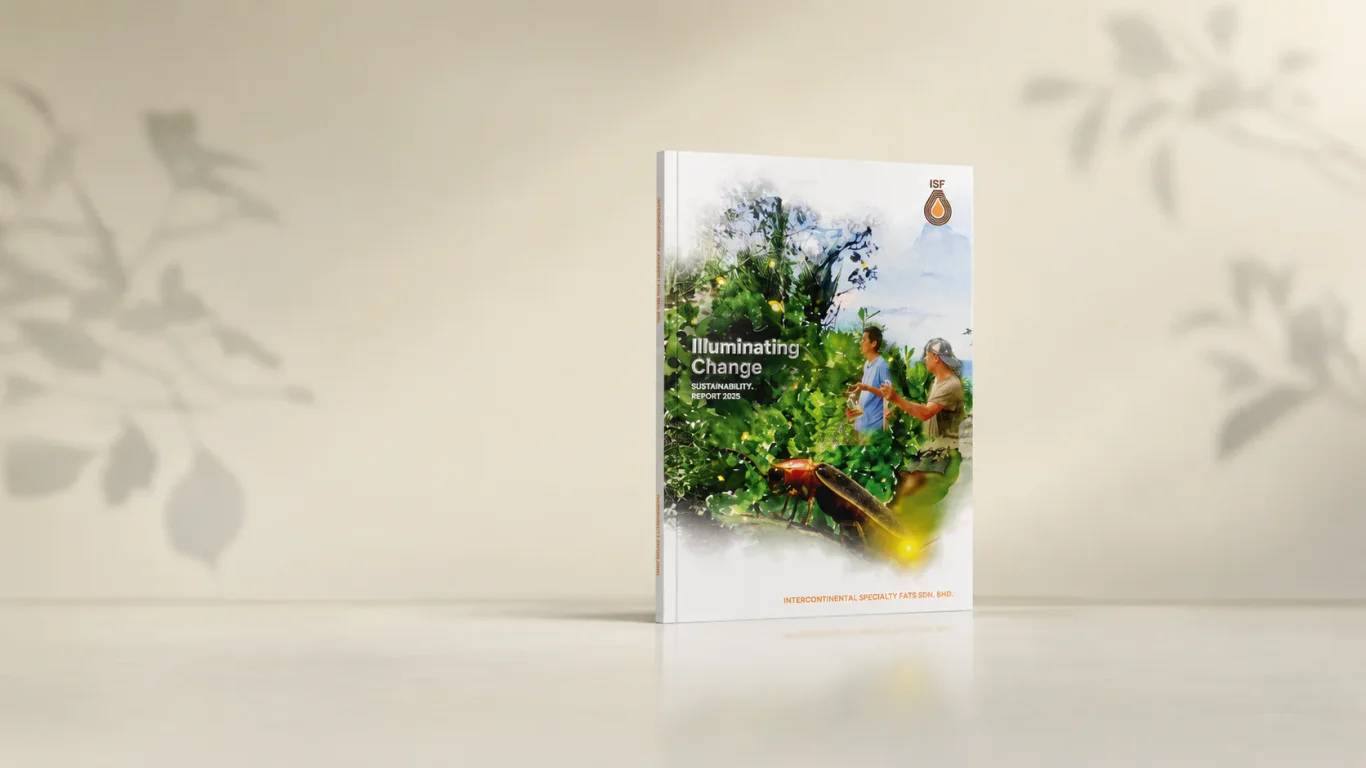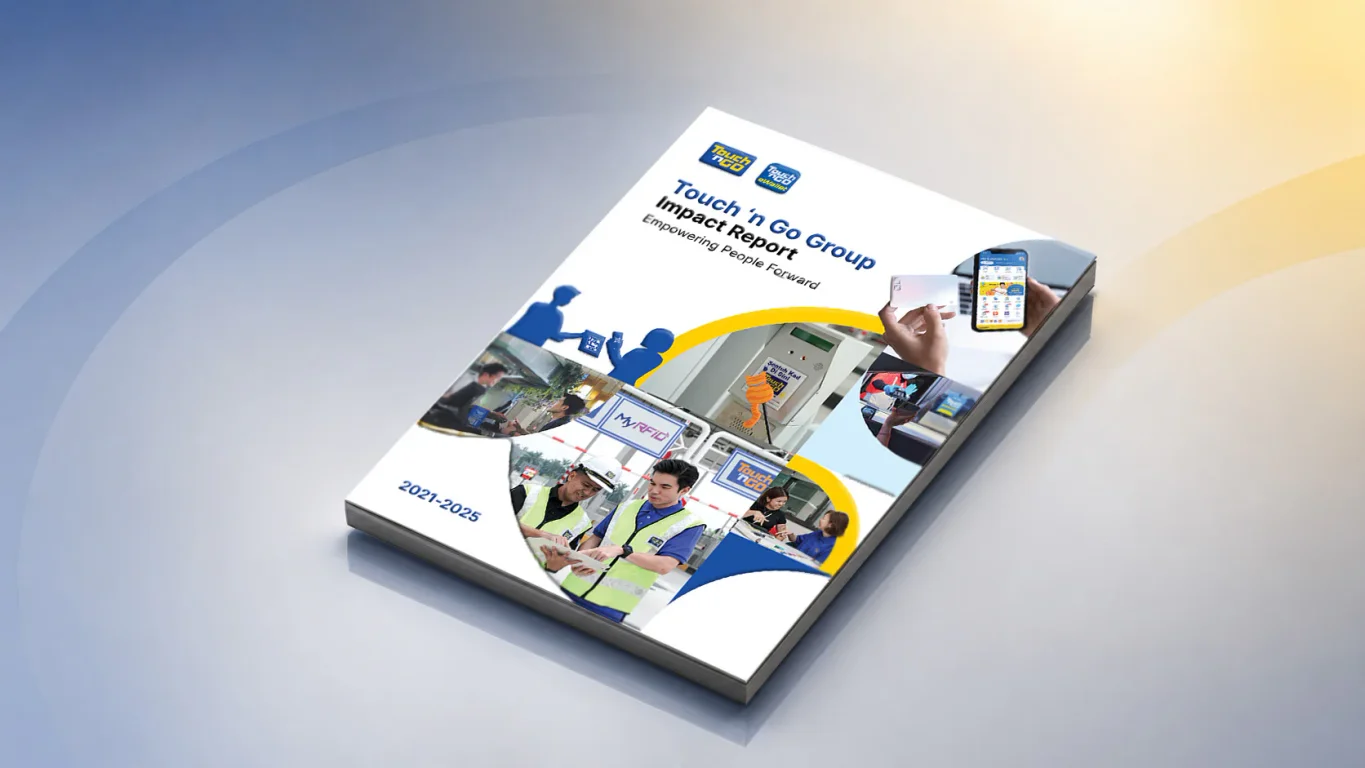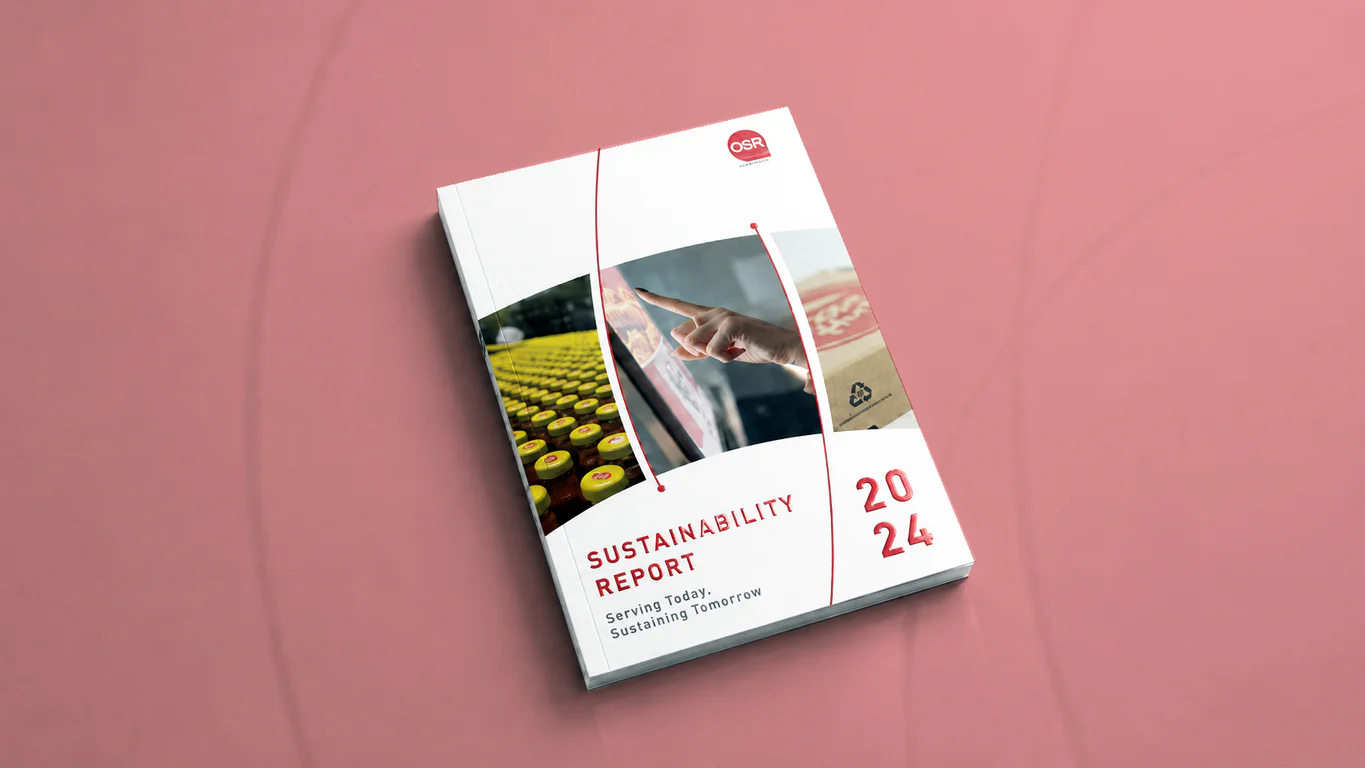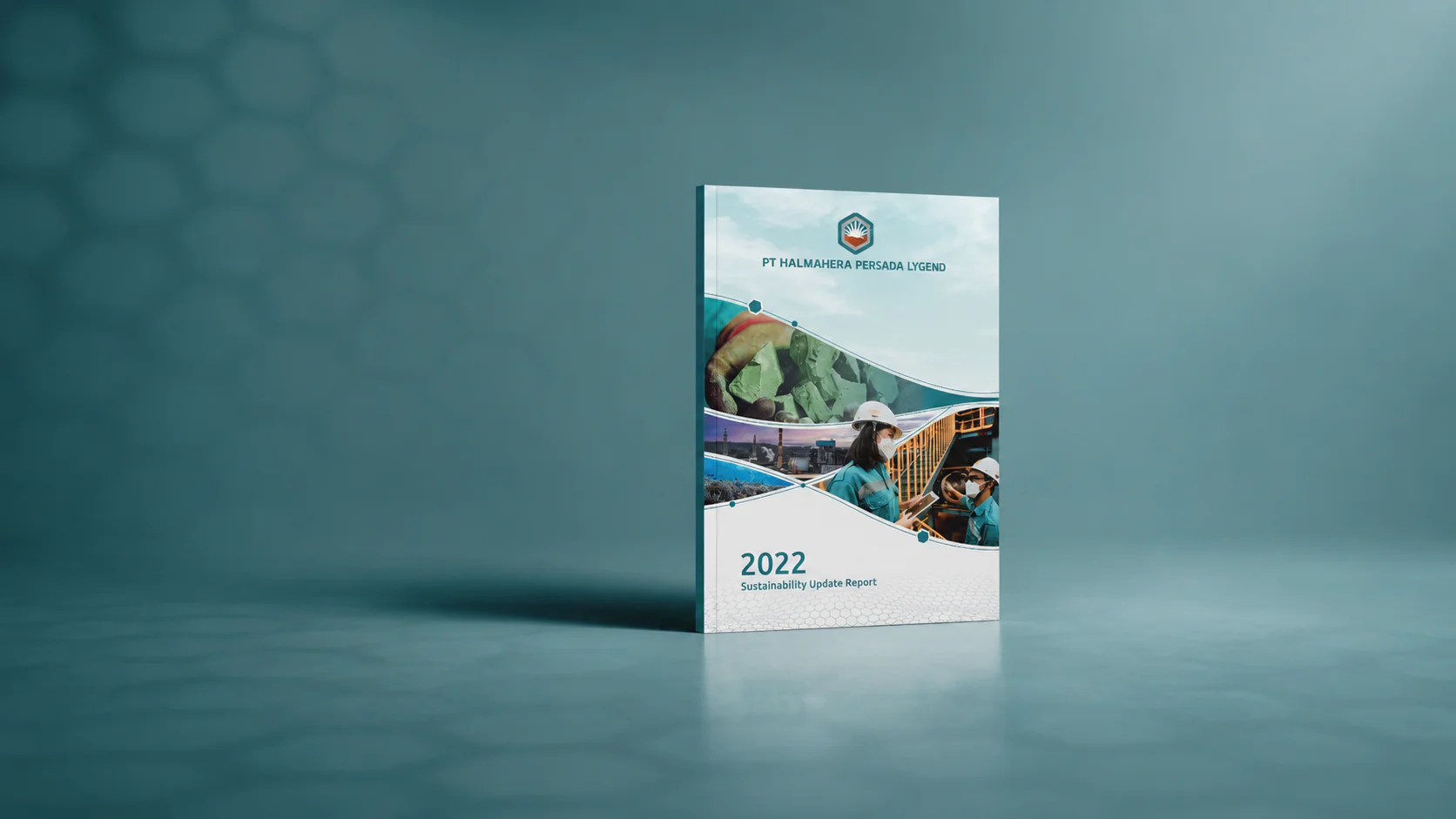
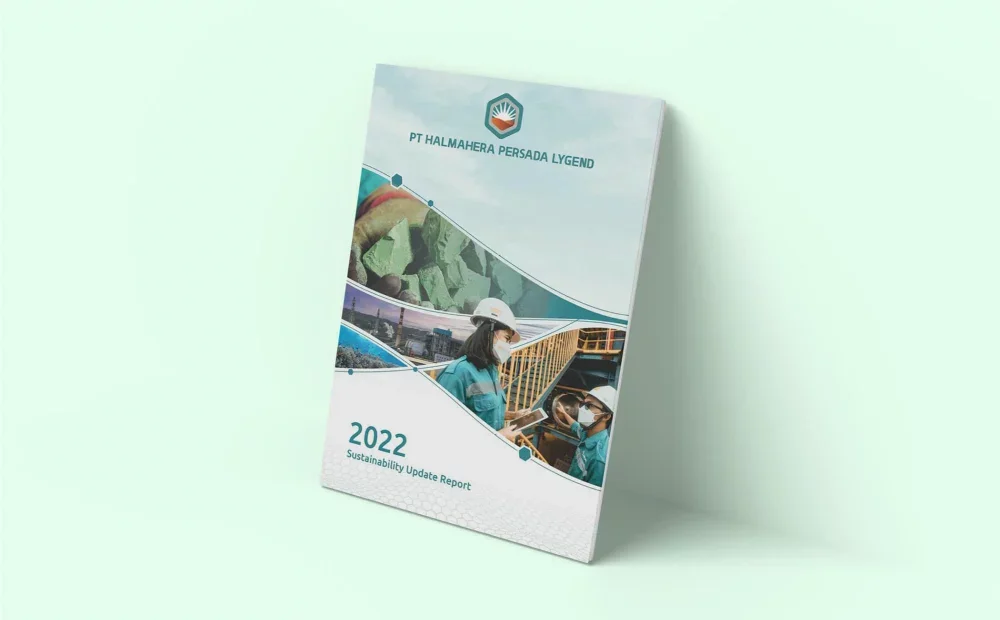
The cover of PT Halmahera Persada Lygend’s 2022 Sustainability Update Report is set in English only. Open it at the sustainability chapter and the page changes: the chapter headline, the running text and every label on the framework diagram appear in English and Simplified Chinese together.
HPAL is a nickel processing and refining company based in Indonesia. It appointed Walk Production for the sustainability report design of its 2022 update, with a scope covering conceptual development, visual and layout design, and project management. The content was client-supplied operational and sustainability information. The finished report had to serve English-speaking institutional investors and Chinese-speaking stakeholders from a single document.
Which parts of the report carry both languages?
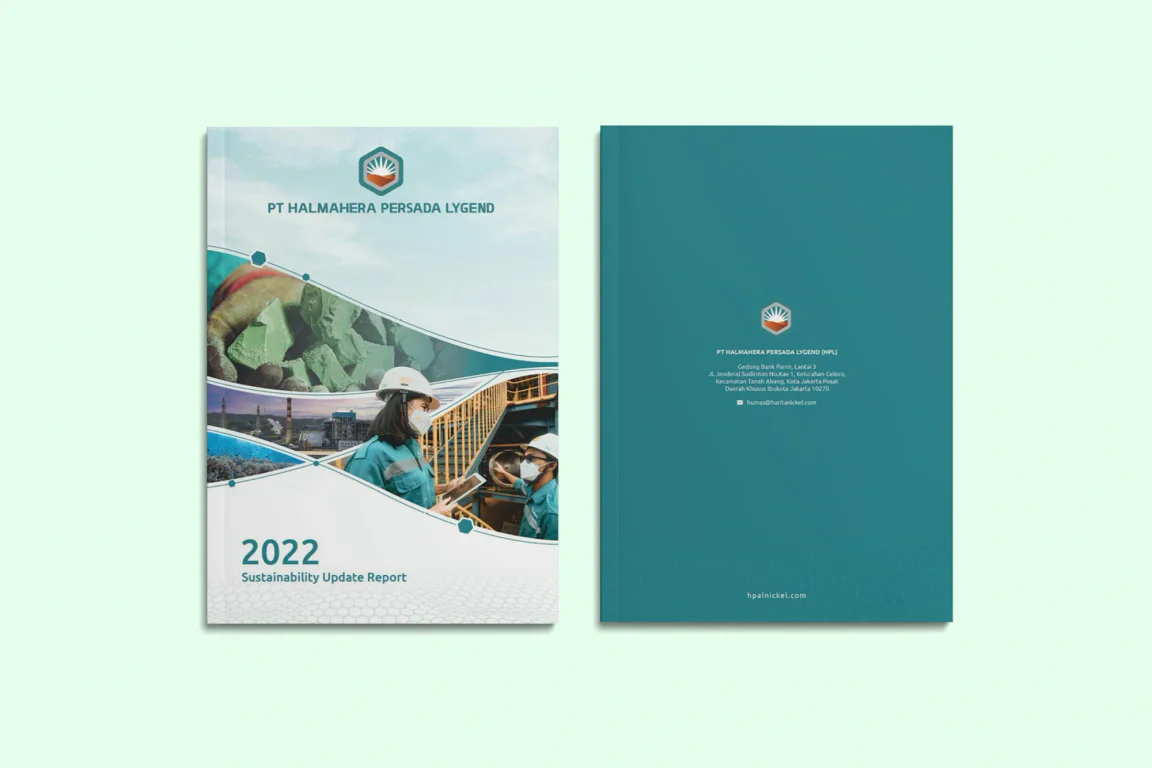
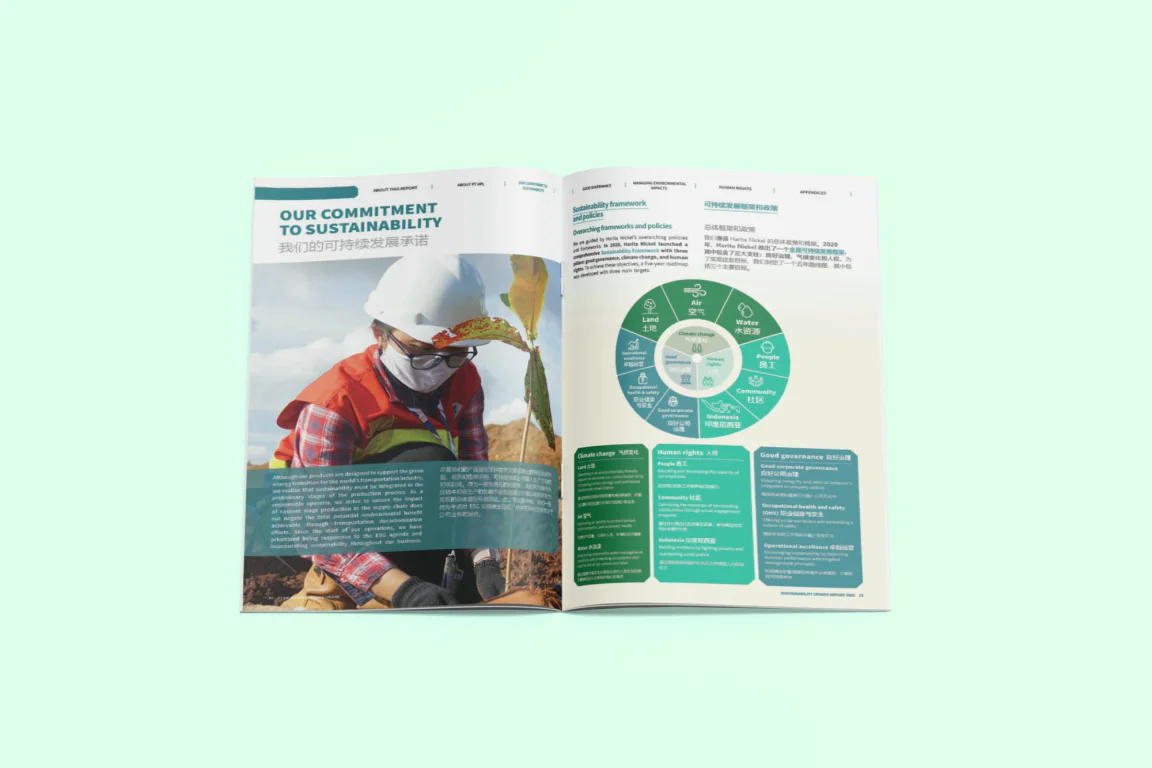
The content carries both languages and the navigation carries one. On the spread shown below, headlines, running text, diagram labels and the pillar panels are set in English and Simplified Chinese. The cover, section tabs and page footers stay in English, which keeps the row of section tabs to a single line across the top of the page.
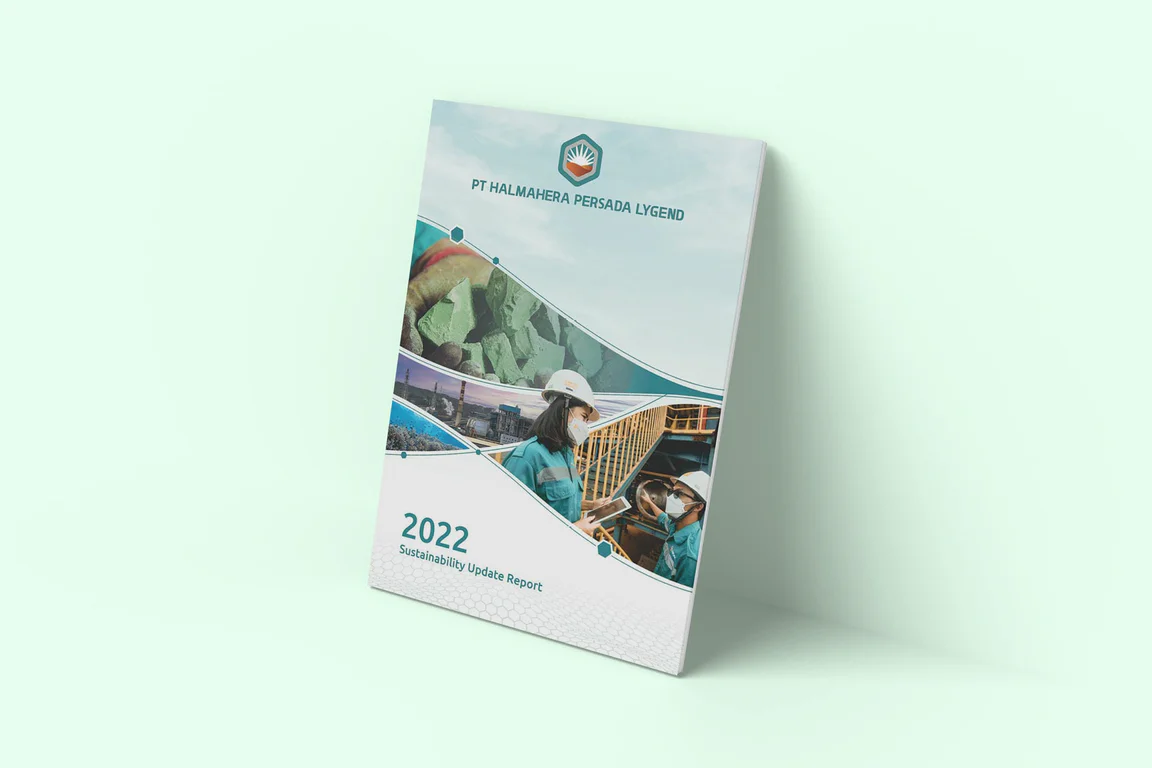
- Covers. No Chinese text. The front carries the company name, the year and the report title in teal. The back cover is solid teal, with the logo and contact details.
- Section tabs and footers. English only. Seven tabs run across the top of the spread, from About This Report to Appendices, and the current chapter is picked out in teal.
- Chapter headlines. Both languages, stacked. The English headline is set in large teal capitals, with the Chinese headline directly beneath it in a lighter gray.
- Running text and section headings. Both languages, side by side. English takes the left column and Simplified Chinese the right, each under its own heading, so a reader can move between versions without turning a page.
- Diagram labels and panels. Both languages, stacked in place. Each label on the framework wheel gives the English term with the Chinese term below it. In the panels under the wheel, each English description has its Chinese version directly beneath.
Two columns, two text lengths
On the spread shown above, the bilingual passages take up less room in Simplified Chinese than in English. In the teal text panel on the chapter opener, the English paragraph runs several lines longer than the Chinese beside it. The framework introduction on the facing page shows the same pattern on a smaller scale, and the layout had to absorb that gap without leaving either column stranded.
The publication layout was calibrated for that difference. Typography and line spacing were tested across content types, from narrative passages to data tables, and column ratios were adjusted to keep the two versions aligned. Each spread was then reviewed so that neither language looked crowded or unbalanced.
The chapter opener shows a second answer to the same problem. Its bilingual text sits in a translucent teal panel laid over the lower part of a full-page photograph. Because the panel has a fixed edge, the shorter Chinese column still sits inside one clearly defined block.
How the framework wheel maps the report
The central framework infographic is a wheel. Three pillars sit at its center: climate change, human rights and good governance. An outer ring divides them into nine focus areas, three per pillar, each with an icon and a bilingual label. Readers see the whole framework on one page before the chapters go into detail.
The focus areas are Land, Air and Water under climate change; People, Community and Indonesia under human rights; and good corporate governance, occupational health and safety, and operational excellence under good governance. Each pillar has its own color family: deep green for climate change, a lighter teal-green for human rights and a blue-teal for governance. Three panels beneath the wheel repeat those colors and give every focus area a short description in both languages. A reader can trace any segment down to its explanation by color and by label.
The wheel also previews the structure of the report. Three of the seven section tabs, Good Governance, Managing Environmental Impacts and Human Rights, follow its pillars closely. The graphic appears early in the report and serves as its reference point, helping readers see how individual initiatives connect to the wider sustainability strategy.
Singapore-listed companies have a version of the same problem to solve. SGX Mainboard Rule 711B requires a sustainability report to describe sustainability practices with reference to primary components that include material ESG factors, policies, practices and performance, and targets. A single diagram that shows how those parts connect is one way to orient readers before the detail begins. Which components apply, and how to meet them, is for each issuer and its advisers to confirm on the SGX Rulebook.
Cover, palette and photography
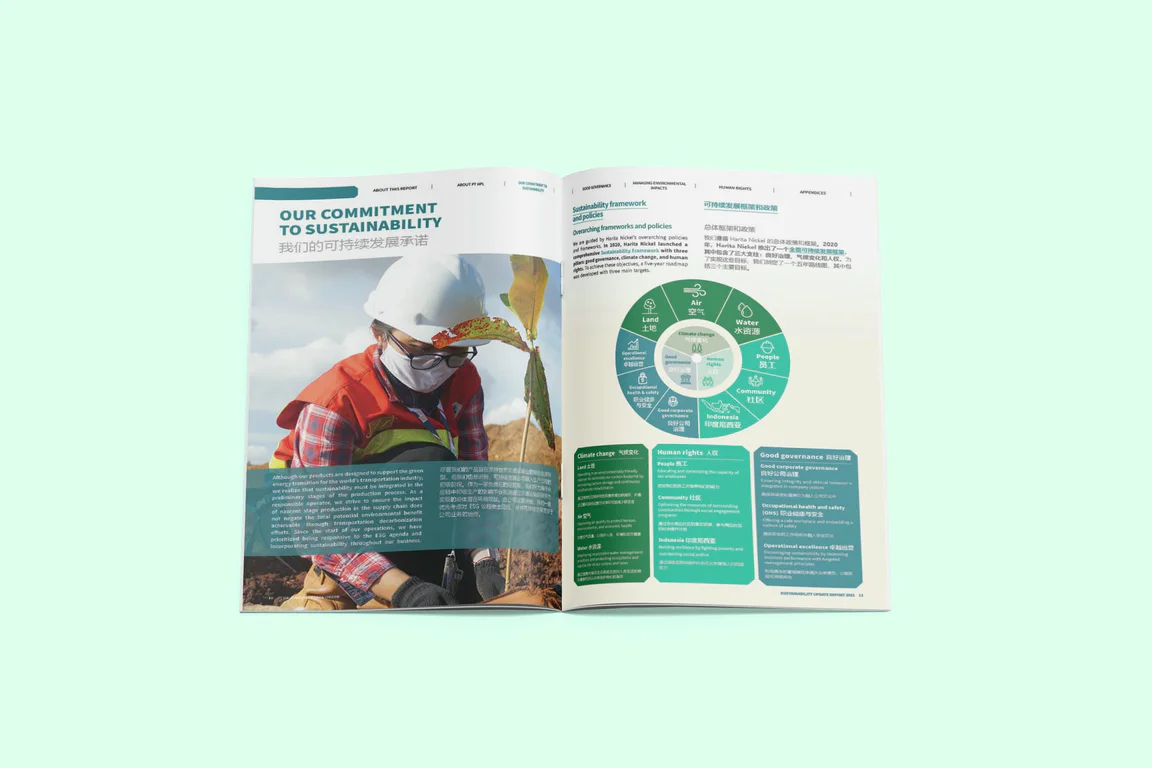
The cover introduces the palette and motifs used inside. Curved teal lines cut it into wave-shaped bands that carry four client-approved photographs: nickel ore in a gloved hand, an industrial plant with tall stacks, a marine scene, and two masked workers in teal workwear and hard hats, one holding a tablet. The year and title sit in teal on white below them.
The hexagon from HPAL’s logo recurs as small markers along the wave lines and as a faint honeycomb texture at the foot of the cover. The concept drew on environmental stewardship, and the soft teal and green tones support that theme while keeping the measured tone expected of an industrial-sector ESG publication. They also give the report an identity of its own, distinct from standard corporate documentation.
Inside, the sustainability chapter opens on a full-page image of a masked worker in a hard hat, crouched beside a sapling. Client-approved images from HPAL’s processing facilities, environmental rehabilitation areas and community engagement activities were curated and color-corrected so the set holds together across the report.
How the two language versions were checked
Each language went through its own review. Project management for the report added steps that a single-language report does not need: separate review cycles for the English and Chinese versions, cross-checks that each translated passage sat with the right visual element, and data points confirmed against source material in both versions.
Those checks matter most where the two languages share a graphic. A figure quoted in both columns has to match in both. A label on the wheel has to match the panel heading below it, in English and in Chinese.
What did HPAL receive?
HPAL received a bilingual sustainability update that English-speaking institutional investors and Chinese-speaking stakeholders can read from the same document. Because the versions run side by side, neither audience has to move between separate editions. The report works as a disclosure document and as a tool for stakeholder engagement, and it gives the company a reference for future reporting cycles. The published edition is available as a PDF through the report link above.
Related Questions
What is a sustainability update report?
A sustainability update report gives stakeholders a progress check on a company’s sustainability commitments, usually in a shorter format than a full report. HPAL’s 2022 edition runs from About This Report and About PT HPL to Our Commitment to Sustainability, then Good Governance, Managing Environmental Impacts and Human Rights, with appendices at the back.
How do you keep English and Chinese columns aligned when one runs longer?
Plan the grid around the gap. For HPAL, typography and line spacing were tested on narrative passages and data tables, column ratios were adjusted, and each spread was reviewed so neither version looked crowded. Where text sits in a panel, the panel’s fixed edge holds both columns together. For short labels, stacking the Chinese under the English keeps each pair in one place.
Does Walk Production design reports in Chinese and English?
Yes. Walk Production designs bilingual and multilingual publications, including English paired with Simplified Chinese, Bahasa Malaysia or Bahasa Indonesia, setting Latin and character-based scripts within one layout. For HPAL, the scope was conceptual development, layout design and project management, and each language version went through its own review for layout and readability.
Do SGX rules say anything about releasing documents in English?
In specific cases, yes. Under SGX Mainboard Rule 217, a foreign issuer with a secondary listing need not comply with the Exchange’s listing rules, provided it undertakes, among other things, to release all information and documents in English to the Exchange at the same time as they are released to its home exchange. For such a company, the English version cannot lag behind the version filed at home. Confirm current obligations with your advisers; Walk Production does not give listing or legal advice.
Does Walk Production advise on ESG reporting frameworks?
Yes, sustainability consulting is available alongside our writing and design work. The consultant on the project, appointed by the client or drawn from our partner panel, confirms the framework, data and disclosures. On HPAL’s report, Walk Production’s role was concept, layout design and project management, working from client-supplied content. Audit, independent assurance and legal advice are not provided and stay with the client’s appointed providers.