One document for every business line
Putting a company’s whole service portfolio into one profile is mostly a question of order. OpenSys (M) Berhad is a financial technology company based in Malaysia, with solutions that include Inward Cheque Clearing and bill payment kiosks. It wanted every line of business in a single reference document for industry stakeholders and potential business partners. Walk Production produced the company profile, covering concept development, content planning, copywriting, graphic design, project management, and final artwork for print and digital use.
A brochure for one product can assume what its reader wants. A profile for the whole company has no such luxury. The same pages reach a strategic decision-maker weighing a partnership and a technical evaluator checking what a system does. The concept phase settled how the capabilities would be structured so that one set of pages could serve both readers.
Planning the sequence before the copy
Content planning mapped OpenSys’s service architecture into a narrative with a clear route through it. The gallery spreads show the shape of that route: an About Us spread, a mission and core values spread, and solutions pages grouped by product family. A reader who wants the company story has it in the About Us and values spreads, and an evaluator can turn straight to the family they are assessing.
Pacing was planned alongside the sequence. Data-driven service pages alternate with narrative sections that give market context, so the reader is not asked to take in product detail page after page.
Writing for the partner and the evaluator
Our B2B copywriting team built a messaging framework around the problems OpenSys solves for its clients. Technical expertise is described in those terms, and plain words replace jargon wherever the meaning survives the swap. Each capability is stated as business value first, with the technical specifics close behind.
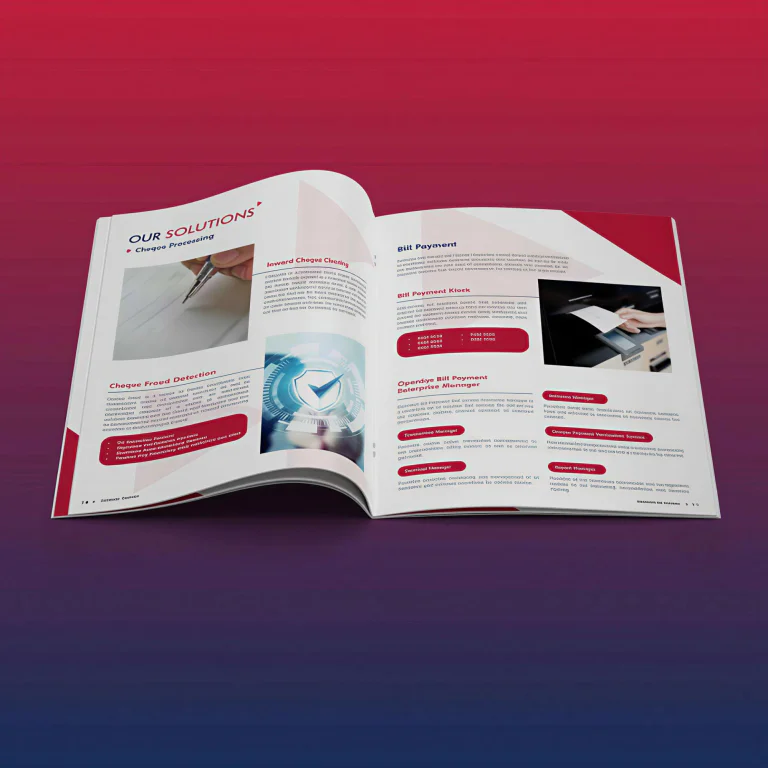
The solutions pages carry that approach into the layout. Each product gets a red subhead, a short description, and, where a list helps, a red panel of bullet points. A decision-maker can scan the product names alone. An evaluator can read the paragraph beneath each one for what the system does.
How the spreads are built
The delivered spreads repeat a small set of devices:
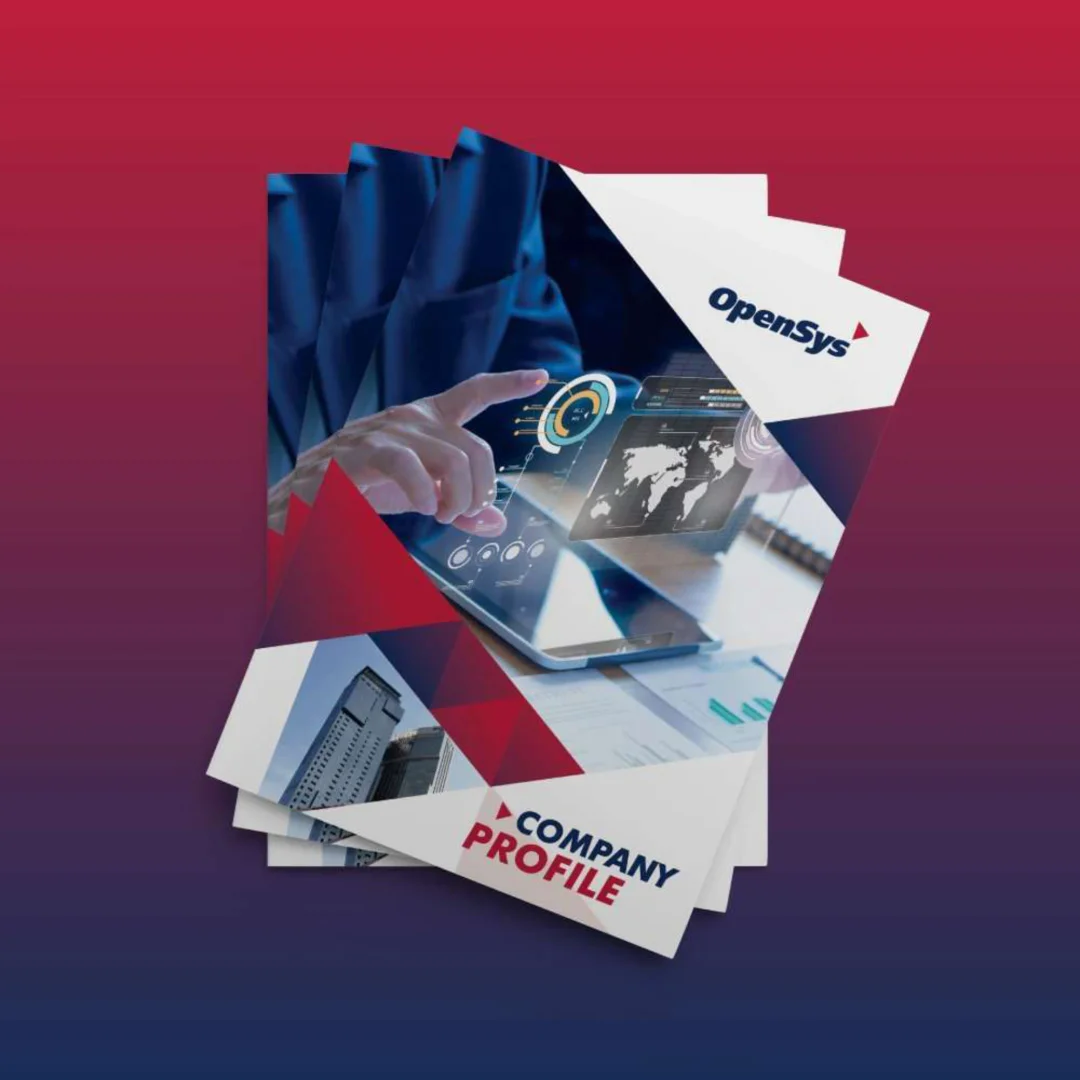
- Cover. The OpenSys wordmark sits on a white diagonal panel at the top right. A photo of a hand working a tablet, overlaid with charts and a world map, fills the center between red and navy triangles. “Company Profile” runs across the foot in navy and red.
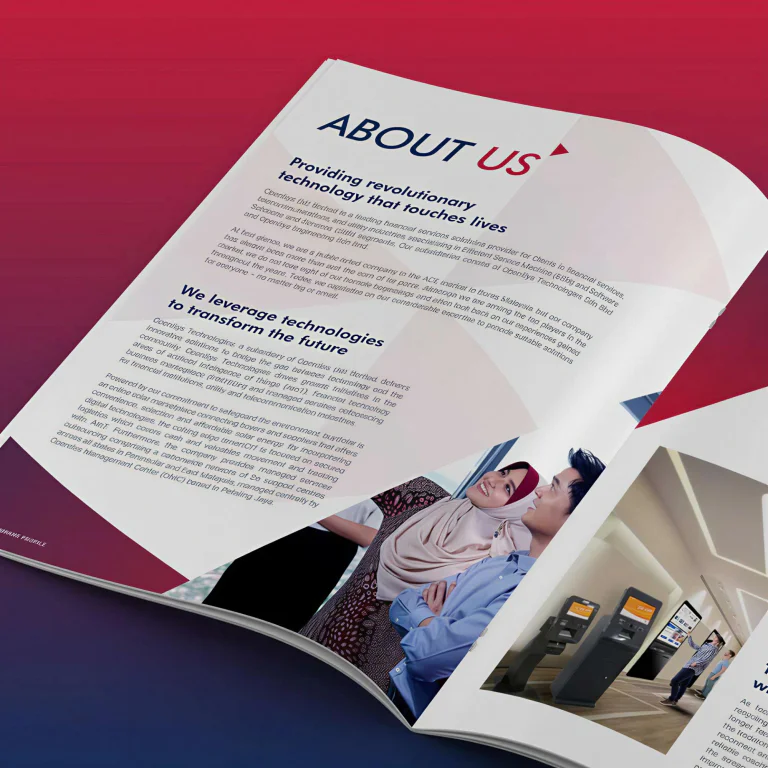
- About Us. The title is split by color, with “About” in navy and “Us” in red. Two navy subheads divide the company introduction, a portrait image is cut on the diagonal by a red panel, and the facing page shows a row of self-service kiosks.
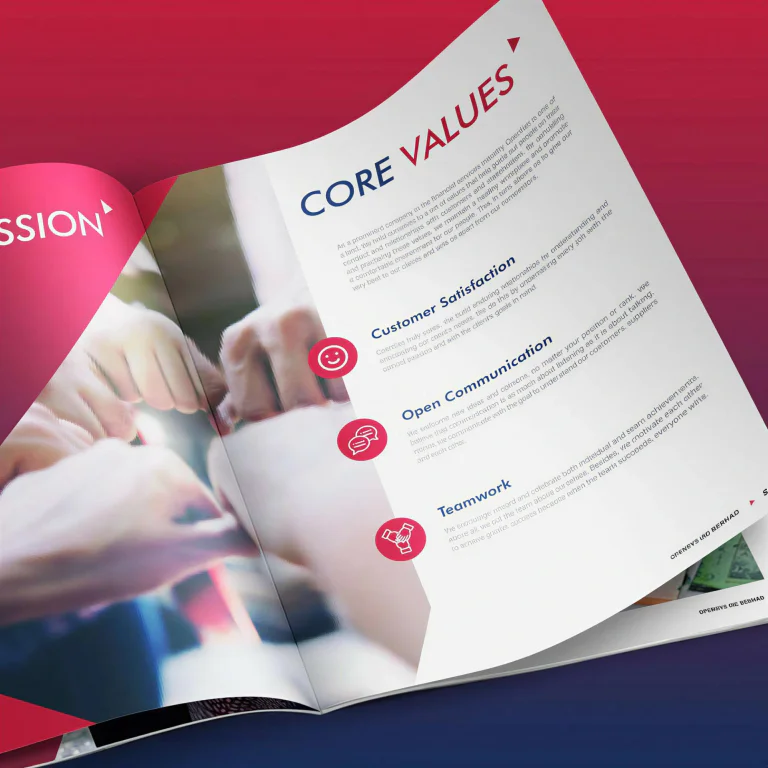
- Mission and core values. The mission heading is reversed out of a red band over an image of stacked hands. Opposite, Customer Satisfaction, Open Communication and Teamwork each sit beside a white line icon in a red circle.
- Our Solutions. Cheque Processing holds Inward Cheque Clearing and Cheque Fraud Detection. Bill Payment holds the Bill Payment Kiosk and an enterprise manager product, whose components are tagged with red pill-shaped labels. Product names sit in red above a thin navy rule.
A visual system drawn from the logo
The red triangle in the OpenSys wordmark does most of the wayfinding. It follows each section title in the gallery spreads, points into the cover title, and serves as the bullet beside the Cheque Processing heading. A reader learns one mark on the cover and meets it again on every spread shown here.
The same shape scales up into the triangular overlays and diagonal cuts that frame the images, which gives a text-heavy document some movement. Color stays within red, navy and white. Section titles set their first word in navy and their second in red, and pale triangles sit behind the body text on the About Us pages.
Headings use a geometric sans-serif, and white space keeps the product pages from crowding. The value icons share one line style and one container shape, the discipline we also apply to infographic design work.
Keeping the production on schedule
Project management covered the timeline from the first briefing through design iterations and content reviews. Walk Production coordinated across OpenSys’s internal teams through the reviews, keeping the schedule and quality standards in step. Final artwork was prepared for both print and digital channels.
What the profile gives OpenSys
OpenSys now works from one document that covers its full service portfolio, where it previously relied on separate materials for each business line. The profile supports business development conversations with stakeholders and partners, and it presents technical capabilities in a form that non-specialists can follow.
Because the family groupings, red subheads and panels repeat across the solutions pages, a reader can scan for one capability or read a whole product family in depth. The same document handles a first introduction and a detailed technical review.
Project Gallery
Related Questions
How do you organize a company profile when the business has many product lines?
Group the products by family and give every family the same page structure. In the OpenSys profile, Cheque Processing and Bill Payment each open under a family heading, and every product below gets a red subhead and a short description. Repeating one structure lets readers compare lines of business without learning a new layout each time.
Who reads a fintech company profile?
Usually two groups inside the same client organization. Strategic decision-makers want the business case and a sense of the company behind it. Technical evaluators want to know what each system does. The OpenSys profile serves both by stating business value first and keeping the product specifics on the same page.
Why build a profile’s visual system from the logo?
A mark readers already know makes a useful navigation device. The OpenSys wordmark includes a red triangle, and the profile reuses it as a pointer on section titles and as a bullet. Enlarged, the same shape becomes the diagonal overlays that frame the images, so the document carries the brand without extra decoration.
How long does a company profile project take?
Our company profile projects typically run four to six weeks, from briefing through writing, design, revisions and final files. Tender profiles can be rushed to two to three weeks when the content is ready. Review cycles and the number of people signing off decide where a project lands in that range.
Can company profile content be reused in a presentation deck?
Yes. Profile copy and graphics can be adapted into a PowerPoint deck that a sales team can present and edit for different audiences. Working from the same source content keeps the printed profile and the slides telling the same story in the same voice.